Frontier · Sub-page
Ethics — the floor, not the ceiling.
Crows are recognized individuals. They remember. Every interaction we run is part of their experience of humans — permanently, for years. The rules below are the absolute floor.
AI narration · Frontier · Ethics floor
The ethical constraints we hold to: no playback experiments without IACUC review, no nest-proximity recording, no city-precise location publication, no commercial use of behavioral data, no claim of translation. We name these explicitly because the AI-assisted bioacoustic space has a recurring failure mode — the field moves fast, the popular framing outruns the science, the actual animals catch the harm. The Earth Species Project's launch framing for NatureLM-audio is the cleanest public version of these constraints. CrowLingo's editorial floor is the same. If a feature on the v1-through-v5 roadmap would violate one of these, it doesn't ship.
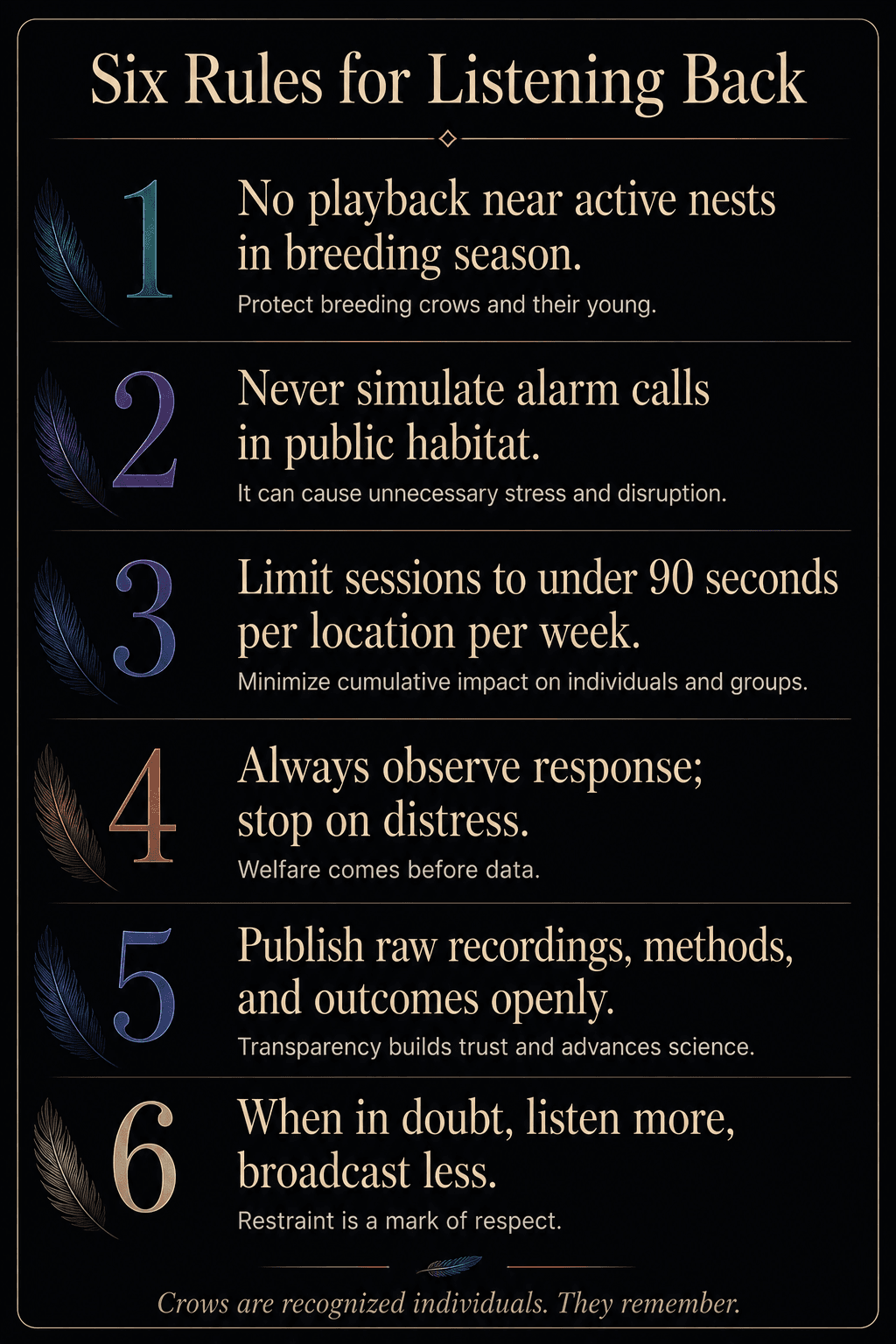
The six rules
- No playback near active nests in breeding season. Reproductive stress is the highest-stakes animal-welfare cost a playback study can incur. The default is "no"; the exceptions are vanishingly rare and require ethics-board justification.
- Never simulate alarm calls in public habitat. Alarm calls recruit. A simulated alarm in habitat triggers a real recruitment response in animals who cannot distinguish stimulus from event. The cost is wasted vigilance budget, disrupted foraging, and cumulative habituation that compromises future genuine signals.
- Limit sessions to under 90 seconds per location per week. Habituation and individual recognition together mean a site you visit for playback this week is a contaminated site for the next 2–4 weeks. Rotate sites; log the visit calendar.
- Always observe response; stop on distress. Distress signals are well-documented (sustained alarm calls, recruitment of multiple individuals, sudden silence + extended fixation, direct flight at speaker or observer). Any of them = halt. The halt is itself a result.
- Publish raw recordings, methods, and outcomes openly. Closed-data behavioral work on animals reproduces the pre-replication crisis of psychology, but with the added cost that we're imposing experiments on subjects who can't consent. Open publication is the price of doing it at all.
- When in doubt, listen more, broadcast less. Most questions in crow vocal communication can be answered with observational audio + behavioral data. Playback is a last-resort intervention, not a default methodology.
What CrowLingo will not do
The four constraints below are project-wide policy. They apply to v0, v1, v5. They are not aspirational.
- No alarm/distress playback files in trivially redistributable formats. Audio that's easy to broadcast at scale by a non-researcher is a tool for harassment. We host such audio only as analysis-quality source for vetted collaborators, never as MP3 downloads.
- No location data finer than city-level. Crow family groups can be located precisely from geo-tagged audio. We coarsen all location metadata to the city level before publication.
- No endorsement of commercial "crow translator" apps. No such product currently rises above entertainment. Several mislead users about the state of the field. We don't link to them; we don't list them in the library.
- No anthropomorphism."The crow said" is shorthand we don't use. "The crow produced a call of type X in context Y" is the boring, correct phrasing — and the boring phrasing is what protects the claim.
How to flag a concern
If you see CrowLingo content (or playback protocols published here) violating this floor, the right contact is contact@kymatalabs.com. Replies within seven days. Errata posted on the page in question.